
Rentals · 7 min read
Short-term or long-term rentals in Brickell: how to decide before you buy

Published
In short
"Vivi, is Airbnb or a long-term rental better for me?"
In this guide
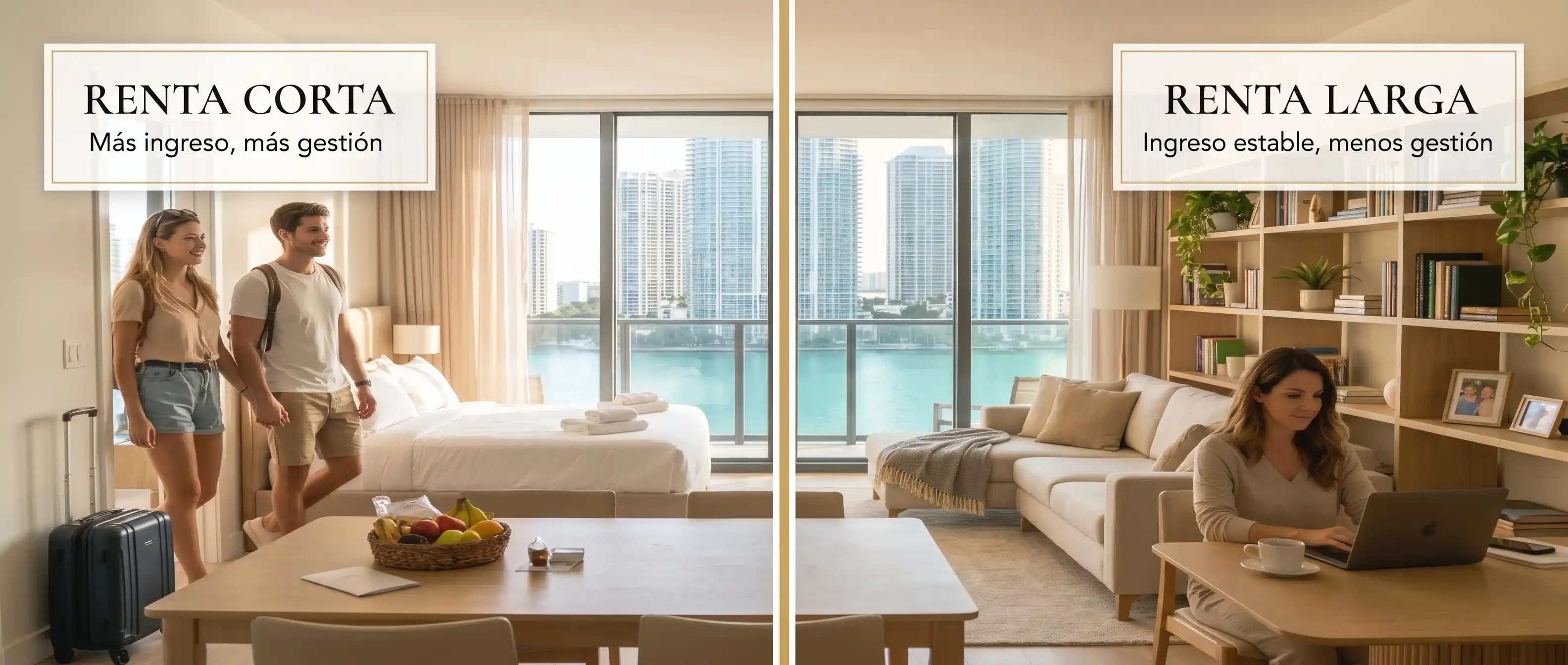
It's one of my favorite topics, because almost every family Ale and I work with buys to rent. My answer: it depends on you, not on the market. Short-term rentals can bring in more gross income, but they come with higher expenses, variable occupancy and are only possible in buildings whose condominium declaration allows them. Long-term rentals bring steadier income and less management. That's why the decision is made before choosing the building, not after. Let me explain why.
The difference in one table
| Aspect | Short-term rental | Long-term rental |
|---|---|---|
| Income | Nightly; can be higher over the year | Monthly and fixed for the lease term |
| Occupancy | Varies with seasons and events | High while the tenant stays; risk of empty months between leases |
| Management and cleaning costs | High: bookings, guests and cleaning after every checkout | Low: one lease and occasional maintenance |
| Wear and tear | Higher; furniture and supplies need replacing | Lower |
| Taxes | You pay income tax and, on top of that, guests are charged taxes on the stay | You pay income tax; taxes on the stay don't apply |
| Building rules | Only where the condominium declaration allows it | Allowed in almost every building |
| Owner's time | High, unless you delegate to an operator | Low |
Neither is better in the abstract. It depends on the building, your budget and how involved you want to be.
Building rules come first
Before dreaming about Airbnb, look at the rules. In Miami, short-term rentals depend on three layers: Florida law, City of Miami zoning and permits, and the condominium declaration. And most residential towers in Brickell don't allow them.
That's why the rules change so much from one building to the next. One Twenty Brickell Signature, for example, is marketed with short-term rental flexibility, while other towers are designed for living in or for long-term leases.
I explain how those three layers work in my guide to short-term rentals in Miami. And a piece of advice I give every family: before you sign, confirm the rule in the condominium declaration during the 15 days you have to cancel.
How to estimate your income
The formula is the same for both options:
Net income = gross income − vacancy − condo fee − property tax − management
An illustrative example for a USD 2 million apartment. The numbers are rounded, don't correspond to any project and are not a return projection:
| Item (per year) | Short-term (illustrative) | Long-term (illustrative) |
|---|---|---|
| Gross income if occupied all year | USD 237,250 (USD 650 per night) | USD 108,000 (USD 9,000 per month) |
| Vacancy | − USD 83,000 (35% of the year empty) | − USD 9,000 (one month empty) |
| Condo fee | − USD 24,000 | − USD 24,000 |
| Property tax (2% of taxable value) | − USD 40,000 | − USD 40,000 |
| Management and cleaning | − USD 55,500 | − USD 7,900 |
| Net income before income tax | USD 34,750 | USD 27,100 |
What does this example tell us? The short-term rental brings in 56% more income after vacancy, but only 28% more net income. And with more work and more variation from month to month. With a different occupancy or nightly rate, everything changes. That's why I always ask for each project's real numbers before recommending one.
Not sure whether Airbnb or a long-term rental is right for you? Tell me your goal and we'll look at it together.
Buildings with an operator: the option to delegate
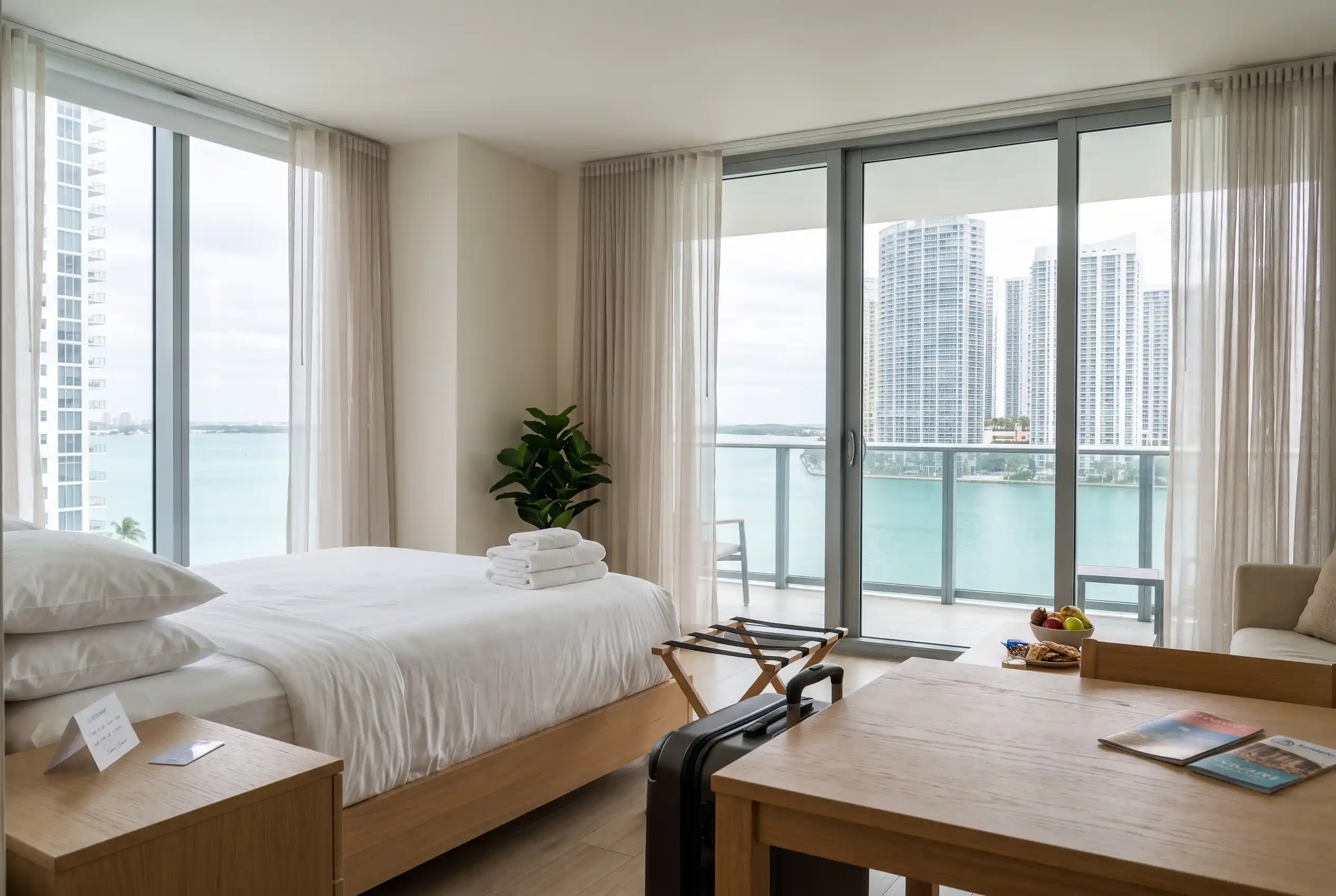
If you're buying from another country, managing guests on your own isn't practical. That's what condo-hotels and buildings with rental programs are for: an operator handles bookings, cleaning, check-in and taxes on the stay, in exchange for a commission on the income.
One example is the Delano Collection at Delano Residences, on floors 20 to 47, which is marketed without rental restrictions and with the services of a hotel brand.
You gain time and peace of mind. You give up some margin and some control: the operator sets rates and the calendar, and your personal use of the apartment usually has rules. Before you buy, ask for the management agreement and check:
- The commission and which costs are charged separately.
- Whether you're required to use that operator or can rent on your own.
- How many nights a year you can use your own apartment.
- How and how often they report income and send your payouts.
Which profile fits each option
If you're an investor abroad who wants to delegate, a short-term rental in a building with an operator may be a good fit. You accept that income will vary and, in exchange, someone else takes care of everything and you can use the apartment a few weeks a year.
If you're looking for steady income, a long-term rental is usually the best companion: one lease, one tenant and as little management as possible from your home country.
Let me tell you a story. An investor from Honduras wanted to invest part of what he had saved for retirement in the United States, after serving many years in the Army. We met at an event, coordinated his visit to Miami and Ale and I toured the options with him. Before talking about buildings, we talked about what he wanted to achieve with his money. He ended up investing in three projects in Brickell. Over time, the relationship went beyond the purchase: today he's a friend of the family, and we spend time together whenever he comes to Miami.
That's how we work: with heart and with order. Your goal first, the building second. It's the first step of our V4 Method.
Frequently asked questions
Vivi, can I switch from a short-term to a long-term rental later?
Generally yes: long-term rentals are allowed in almost every building. If your apartment is in an operator's rental program, first check what that agreement says about leaving the program.
Who manages my short-term rental if I live abroad?
You can do it yourself, hire a management company or, in buildings with their own operator, use the building's. From another country, delegating is usually the most practical option.
How do I pay rental taxes as a foreign owner?
In the United States, rental income is subject to income tax: a 30% withholding on gross income or, if you elect to be taxed on net income, the graduated rates. For short-term rentals, guests are also charged taxes on the stay: in the City of Miami they add up to about 13%. I explain it in my tax guide for foreign owners.
How do I know if a building allows short-term rentals?
The final rule is in the condominium declaration, not in the sales brochure. Ask for that document and check the minimum stay, how many times a year you can rent and whether you have to use an operator. Do it during the 15 days you have to cancel.
Tell me what you want to achieve
Every family is looking for something different from its rental. Message me on WhatsApp or Book your video call and I'll show you the projects that allow rentals based on your goal. Ale and I will be with you from start to finish.
Sources
- City of Miami: short-term rental procedures
- Florida Statute 509.032, chapter 509 (vacation rentals)
- Florida Department of Revenue: taxes on rentals of six months or less (DR-15TDT)
- Florida Office of Economic and Demographic Research: 2026 tourist tax rates by county
- CondoBlackBook: Delano Residences rental rules (floors 20 to 47)
The numerical examples are illustrative and are not an income projection or a promise of returns. Consult a tax advisor before investing.